
You heard that Google gives churches up to $10,000 a month in free advertising. You went to sign up. And somewhere in the process, a screen asked you to prove your church is a 501(c)(3), and you realized you have no idea whether you can.
You are not doing anything wrong. This is the single most common place churches get stuck, and almost nobody explains it clearly.
Here is the clear explanation.
Why your church is tax-exempt but Google can't see it
Under Section 508(c)(1)(A) of the tax code, churches are automatically considered tax-exempt. You do not have to file Form 1023. You do not have to ask the IRS for permission. If you meet the definition of a church, you are exempt the day you start.
That is a real benefit, and it is why most churches never bothered to apply.
Here is the problem. Google's policy requires that organizations obtain recognition of 501(c)(3) status from the IRS. Google verifies this through a third-party service, which checks the IRS databases. And churches that never applied are not in those databases.
So you are legitimately tax-exempt, and simultaneously invisible to the system Google uses to check.
Same story with the software discounts you may have been offered elsewhere. Places of worship that are automatically tax-exempt, or that self-declare, are not eligible for those nonprofit verification programs. You have to be findable in the IRS records.
Find out where you stand in five minutes
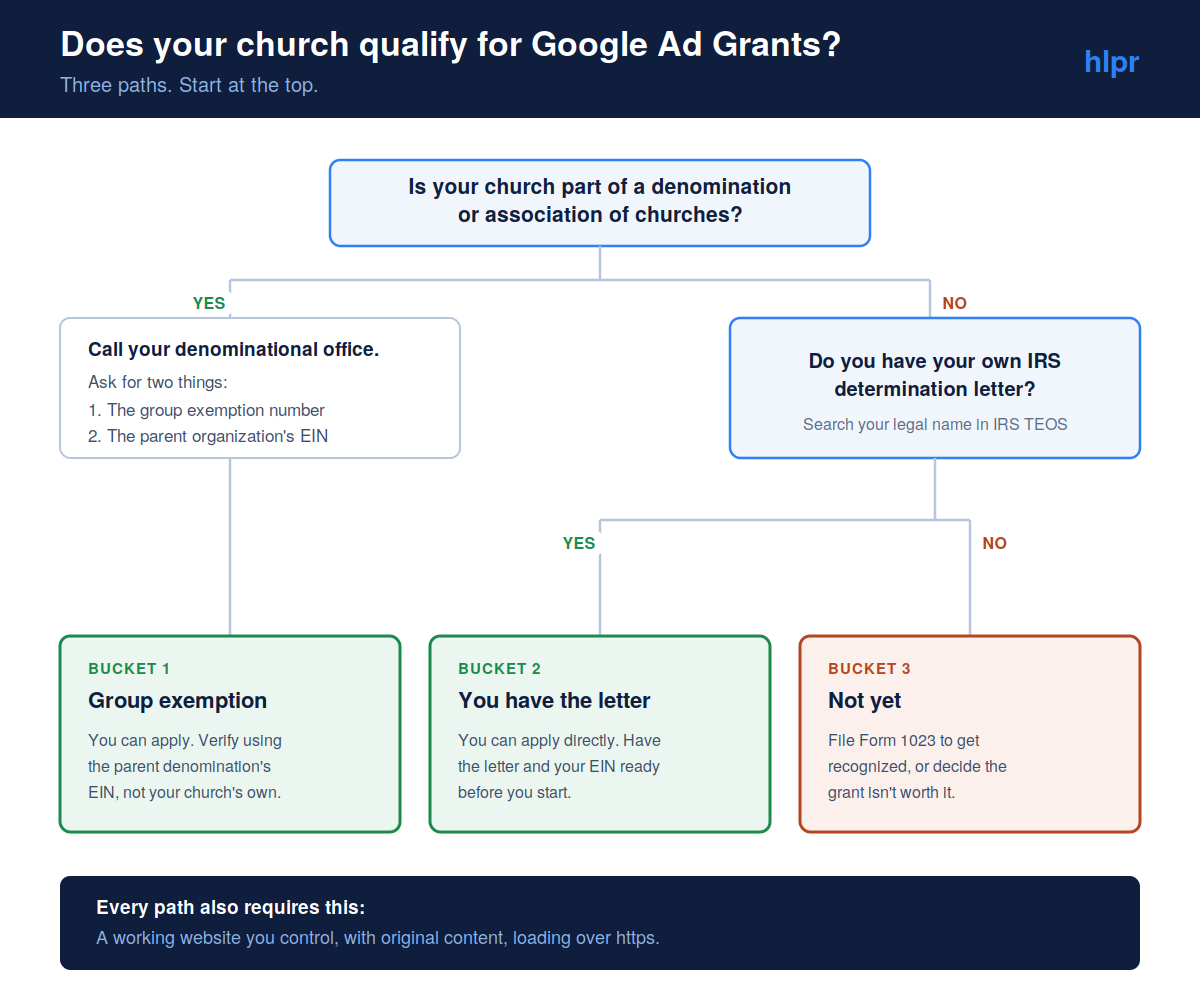
There are three buckets. Almost every church lands in one of them.
Bucket 1: You're covered by your denomination
If your church belongs to a denomination, there is a good chance your denomination holds a group exemption ruling from the IRS that covers its member congregations. Your church is listed as a subordinate under the parent organization.
This counts. Google's own guidance says that if your organization has charity status through a group exemption provided by a parent organization, you may still be eligible.
The catch is that you verify using the parent denomination's EIN, not your own. This is the step that trips people up. They enter their church's EIN, get rejected, and assume they don't qualify.
What to do: Call your denominational office and ask two questions.
- Are we covered under the denomination's group exemption ruling?
- What EIN and group exemption number should we use to prove it?
Most denominational offices field this question regularly and will send you a letter or a directory listing. Keep that document. You will need it.
Bucket 2: You have your own determination letter
Some churches did file Form 1023, usually because a grantmaker or a bank asked for proof at some point. If that is you, the paperwork exists somewhere.
What to do: Search your church's exact legal name in the IRS Tax Exempt Organization Search tool. If you appear there, you are set. If you cannot find the letter itself, you can request a copy from the IRS.
One warning. Some churches show up on the IRS Automatic Revocation list because IRS records classified them as a different type of organization with an annual filing requirement, and three missed filings triggered revocation. A church in that situation is still tax-exempt, but it will need to apply for reinstatement to appear in the databases again.
Bucket 3: Independent, never filed
You are an independent congregation with no denominational parent and no determination letter.
This is the honest answer: you cannot get the Ad Grant in your current state. Not because you aren't a real nonprofit, but because there is no record for Google's verifier to find.
What to do: You have two options.
Option A. File Form 1023. This gets you a determination letter and unlocks the Ad Grant plus a long list of other nonprofit programs. It is not a weekend project. Budget for the IRS filing fee — check the current amount on the IRS Form 1023 page before you plan around it — and for most churches, a few hours with an accountant or attorney who has done it before. Approval timelines vary.
Option B. Decide it isn't worth it. This is a legitimate choice and more churches should make it. If your congregation is small and local, the realistic value of an Ad Grant may not justify the filing. Read the next section before you decide.
The part nobody wants to say out loud
Every article about this program leads with $10,000 a month. That number is technically accurate and practically misleading.
The Ad Grant runs on Google Search only. Your ads appear below the paid ads, not above them. And you can only spend the money on searches that are actually happening.
If your church is in a town of 30,000 people, there is not $10,000 a month of search volume for people looking for a church near them. There might be $200 worth. A church in a major metro with a food pantry, a recovery ministry, and a counseling program has far more to advertise and can spend meaningfully more.
The grant also comes with maintenance requirements. Google requires accounts to maintain a minimum 5% click-through rate, and accounts that fall below can be suspended. Ad copy has to stay focused on community outreach and services rather than proselytizing, which is a real constraint that catches churches off guard.
None of that makes the program bad. Free advertising is free advertising, and a church that gets 15 first-time visitors a year out of it has come out ahead. But go in expecting a useful tool, not a windfall. If someone tells you they will get your church spending the full ten thousand, ask them how.
What else Google checks
Assuming you clear the nonprofit hurdle, the other requirements are straightforward:
- A working website you control, with original content that explains who you are and what you do
- An SSL certificate. Your site has to load as https, not http. If browsers show a "not secure" warning on your church website, that alone will block your application.
- Agreement to the program's terms, including a commitment not to discriminate in the services you provide
The website requirement is where a surprising number of applications die. A site that hasn't been updated in six years, or one that lives entirely on a Facebook page, will not clear it.
Your next step
Start with the phone call to your denomination. It costs nothing, it takes ten minutes, and it resolves the question for the majority of churches reading this.
If you come back with a group exemption number, you can begin the application.
If you come back empty-handed and you're independent, weigh the filing against what the grant would realistically be worth in your community.
And if your website is the thing standing in the way, that is a separate problem with a separate answer, and it is one we can help with.